Brands are becoming media


Here in the Middle East, it’s a little slower on the uptake than what’s happening in the West, but brands today – powered by YouTube, facebook, twitter and even the blogosphere are becoming independent – and relevant – media channels by themselves.

Because, combined with digital production and planning agencies, brands are now increasingly aware of the power of combining owned, earned and paid media. They’re creating content and publishing it, pushing it across channels that they are able to create. They are hiring either creative talent within their own ‘marketing’ functions or are freelancing it out. Or getting agencies in to combine content and media – creating and masterminding editorial, written, video, audio and to-be-shared social and viral content.

This is probably because there isn’t enough good content in the market out there. Brands are increasingly creating and crafting what they want to say or want said about their brands, rather than depend on bloggers and independent creators, or even existing media channels. So, a fashion brand may create their own ‘how-to’ content for a YouTube channel, rather than depend on, here in the Middle East, a Yahoo Maktoob…

Al Jazeera’s new twitter dashboard tracks uprising voice


This is coming from Al Jazeera, and yes, we’re here in the Middle East. After having heard for years that we’re kind of behind everything (including walls of censorship), here’s something that is kind of new, and very much a first-ever from a traditional news channnel that is broadcast (or tradional media) based.

The dashboard tallies the daily number of tweets about developments in each listed country (the site is currently tracking Egypt, Yemen, Libya and Bahrain) and shows the average number of such tweets per minute for each country.

Without a doubt, Al Jazeera were the world’s eyes and ears for the many uprisings that have swept across our part of the world. Often fueled by social media and fanned by thousands of followers across the world, the uprisings were uniquely covered by the Qatari channel – and covered well.

The dashboard provides a quick view of from where and how people use twitter to discuss uprisings in the Arab world. A kind of mash of geographic location and emotion tracker.

What if?

Tunisia. Egypt. Libya. Yemen. Iraq. Oman. Bahrain. Algeria. Morocco. Jordan. What sounds like a list of agency locations across the region is really a country by country trail of the Arab uprisings of 2011. It all started in a small Tunisian town and fueled by the Arab youth’s power to communicate, build momentum and gather information and disseminate rhetoric via the internet and on the street until it became a tumbleweed of a game changer. Often, heads of states have fallen, and in others, change of governments or of those wielding power at ministry levels have been brought on by the people in the squares, on the streets.

It took one frustrated, angry vegetable seller in Tunisia who set him ablaze to usher in the ‘Jasmine Revolution’ in Tunisia – the kick starter. Then, in nation after Arab nation, the youth armed themselves with mobile phones and computers, and brought down the power of the gun toting mighty. The pen vs the sword. And the pen (or mouse) won without fail (even as we’re watching what’s unfolding in Libya).

For the first time, collectively at least, this part of the world has woken up to the power of social and political mobilization via social media. One ‘protester’ from Egypt told me how ‘yet another time America had helped change the goalposts in the Middle East’ this time without flying in troops and tanks. “After all, twitter and facebook are American” he explained. I’ve known Bassem (name changed) for a few years. He has been fiercely anti-American. This time around there was almost a quiet acceptance of a helping hand in the form of technology.

Social media and technology of communicating beyond the print and broadcast media is enabling freedom of speech to levels unprecedented in the region. “People are creating their own channels, most of which are beyond any censorships” observed Fadi Salameh, CEO at MCN and a media guy at heart. “I believe this may change where and how we target these demographics as media planers, down the line when everything has settled” he added.

And one more. With all this grasping of the powers that reside between the tweets and the facebook posts, I wonder (and frankly fear) the Sword of Damocles that the powers that be at these social media HQs will face. How will this freedom of speech, open channel networking, and the absence of censorship or control stand up and be counted when (and not if, is my fear) it’s used by the ‘people’ on the ‘wrong side’? After all, freedom of speech and social media can be radicalized. 140c at a time.

Ad Agencies in Egypt Reopen as Protests Continue in Bahrain


from my blog published in Advertising Age
http://adage.com/globalnews/article?article_id=148943

MCN Chairman Akram Miknas has a view down to the square where the protests in Bahrain are unfolding, swelling, gripping yet another Middle Eastern nation. He is mesmerized. One by one, in countries where people feel marginalized, deprived and where they have no voice, they’re gathering togther to say ‘Enough!’. But this is Bahrain and Miknas has a love and long history here. He and his family are honorary citizens – a very rare honor. Over frantic calls from family and friends, Miknas watches the gathering masses, not knowing what would happen next, and wonders how the next few days would affect his advertising businesses, his clients, his country.

MCN – an Interpublic majority owned company runs several key agencies in the region – including McCann FP7, UM, Lowe, Initiative, Weber Shandwick, MRM and more – and Miknas has seen the industry and his business being affected. In Egypt, the office has come back to life now, playing catch up after more than week of shutdown, but it’s been really bad for business. In Tunis, things are normal again, but who knows, Miknas fears, what is about to unfold across the region. Clients aren’t always very bold in uncertainties – media plans and tv shoots get cancelled in seconds. Business can move from great to good and spiral into ‘wow, now what’ in hours.

As I post, Thursday Feb 17th noon here, things aren’t going well. Bahrain police have catapulted the situation into high alert – aggravating the protesters. Tomorrow is billed to be huge there. All social is buzzing. Caught between the fight for rights, between sectarian (Shia vs Sunni) stands, and not knowing what they’re shouting for, it’s a mess. No better in Libya. No worse in Yemen. No nothing in Iran, for fear of getting killed. And, steady, steady, wait and watch in Egypt. Oh, and our industry?

More than one client is asking the social media question. If everyone’s attention is on the social channels or on protest-centered news, how come media planning agencies haven’t scrambled and gotten into the social action more heavily? How come the creative agencies haven’t quickly responded with viral videos and interesting creative that would thrive on this new focus?

The advertising industry is playing cautious. Every one is quick to recognize the mobilization tools for the protests – the internet, mobile, social media – but we’re not seeing quick shifts away from traditional tv and print into social and search built around the new momentum for brands. Particularly for global and regional brands who have no idea which way the power tides shift. And who have to remain loyal to the immediate. “How come your brand won’t wave our flag now?’ asked one protester, about why brands were shying away from taking the side of the young, and supporting them with wither “direct or subliminal support”. “We will remember this” he warned me.

Starting in Tunisia, then rolling across like thunder in Egypt, Bahrain, Libya, Yemen and Iran – this whole new age concept of freedom across the internet is contagious – and the youth in this region are clicking on faster then you can say democracy. And, lest we forget, more than 55% of the population in this region is under 24. And a huge number of them have mobile and 24/7 access to the internet.

One client-side marketing manager, at a key regional pitch for a rather large account in the region, pointed out that all the econometric modeling and media absorbtion predictive tools had gone for a toss – they didn’t see #Jan25 coming. Nor the emergence of Al Jazeera TV as a channel with their live coverage. Or google as a tool for the information hungry.

So, no, TV wasn’t top dog in Cairo for the youth segment the last couple of weeks. Nobody was watching our spots. Advertising as we knew it in the region with tv as hero was suddenly in flux. Messages were more real time, more crisp, shorter, relevant, behaviorally targeted in the immediate. They weren’t formatted for 30s. They were 140c.

Posted on February 18, 2011

Fighting With Social Media Until Now, Egyptians Prepare For More Physical Battle

From Advertising Age / Global News


It’s very early morning in Cairo on Wednesday and I’m being told on the phone that the protesters are bracing for the worst. Omar Sulieman, the Egyptian vice president, has warned that his government “can’t put up with continued protests,” reflecting the regime’s wrath at what’s now 16 days of pro-democracy protest that’s had global coverage. With his “no ending of the regime” stand getting even harder, and the protesters even more determined to “stay until they go,” most of my contacts are preparing for an all out. “We’ve tried hard on Facebook and BlackBerry Messenger,” said Ahmed. “Now we’re preparing for battle.”

The revolution may no longer just be tweeted. It will be bled.

Necessity is the mother of intervention. When all else failed, they went Bluetooth and memory stick. Day after day, as one communication door closed down, the people in Egypt have used new doors and intervention and invention. When all electronic channels were shut down, it went physical. Tahrir Square, #Jan25, #Egypt. The first “phygital” revolution in history.

Change doesn’t happen on a social network alone, change happens on the street. It’s physical, it’s blood, sweat, fire, rocks, bullets.

There’s a set of the urban hip in Cairo who are now pounding the streets in Tahrir Square in their Converse who’ll claim it all started on their ‘Berries and iPads. This is a modern-day revolution, with keyboard and mouse instead of guns and Molotov cocktails or sticks and stones.

“We’re winning this on information,” claimed a young advertising executive who was involved. Shared information, where-to and how-to tips kicked off and mobilized this uprising. Starting, we are told, on Facebook. And then it picked up momentum across various channels of communications, like Twitter, BBM, voice-to-tweet, open IPs and physical memory-stick sharing.

An uprising is a mass thing, and the mass doesn’t reach critical until it involves a cross-strata of society. This time around, the socially adept, technologically enabled urban youth got involved, and often actually activated the masses because they felt empowered and enabled. “What’s different this time around here in Egypt is that this isn’t just a bunch of disgruntled, unemployed young men hurling rocks,” said a colleague, comparing the situation to some other parts of ongoing intifada in the region. They’re educated, aware, and unhappy. They’re hurling tweets.

One poster boy in Tahrir Square this time is Google’s marketing head for the Middle East and North Africa: Wael Ghonim, blogger and activist. When he disappeared off the streets, locked up by the authorities for socially mobilizing the uprising on Facebook and helping push #Jan25 to unprecedented trending, the social networks were rife with anger and acceptance. If you blog, they arrest you. You are known by your handle. And then, on his release on Monday, there was widespread celebration and a whole new momentum fueled by victory.

The other thing we’ve noticed this time is that the people have intervened and invented in amazing ways beyond text. People are turning not working into networking. We’ve seen dozens of photos and handheld videos shared on the internet, but they’re often passed on physically to start with. Digital cameras and camera phones are enabling the street-citizen journalist. And a lot of these were handed over to foreign journalists in various formats, on the street and in hotel lobbies. When Al Jazeera was allowed back on, their Creative Commons has helped the people of Egypt find their audio — and video — voice.


Posted on February 18, 2011

Live From Tahrir Square: What Egyptians Are Tweeting Today


From Advertising Age/Global News:

Well, they got @Sandmonkey this morning. The Egyptian micro-celebrity and blogger Mahmoud who goes under the handle Sandmonkey was put in a cage, arrested. Not much of a surprise, and a bit too late. He’d already got the word out, tweet by tweet, video upload after another, and he had done enough social damage to #Mubarak. He moved the dictator towards #epicFail. As the internet opened up a little, protesters were tweeting live from the now legendary #Tahrir Square. And the world is following. Most related topics are trending on top 10 as I post, in the U.K., in Canada, and in the US. One way or another, one hashtag or another, #Jan25 and #Egypt is captivating tweet.


The world is watching in awe as social media is playing a small but significant part in tearing at decades of repressive regime. In London, #Jan25 is higher at No. 2 than the happier celebratory #Kung Hei Fat Choi for Chinese New Year. In India the topic holds four of the top 10 slots. I read on a tweet that more people are following the Egyptian revolution on social worldwide at any given time than on TV. The revolution is not on television! Social is helping today’s frustration, anger, and resentment amongst the literate youth be voiced with a loudness unprecedented. And, hush, but a little bird says that the power of social is kindle, waiting across many a Middle Eastern flashpoint. Scary.


In Egypt, friends are now being able to contact us. They’re telling us how the entire narrative, the tide was turning one way, then another, mostly in a well mannered way using the power of next gen media. Groups are organizing quickly. Information was being passed, bloodbank requests were being RT’d and doctors responding. And Washington was being beckoned to action. The world was being told. Minute by minute. My tweetstream on #Jan25 is flowing so fast, I simply am unable to catch any of it. The news channel Al Jazeera is running a live Twitter feed on their portal. Uploads are flooding YouTube, and #Jan25 is getting thousands of likes on Facebook. For once, an entire world is following a revolution 24/7. This is huge.

However, saying it’s a social media revolution would be belittling the hundreds wounded and scores who have given up their lives. This is not a revolution about armchair or laptop protesting. It’s not about ‘leaning back’ (watching it on tv) or ‘leaning forward’ (participating via laptop). It’s out on the street. It’s being written in blood. Young and old Egyptian blood. But as our friends from Cairo tell us, social media, and channels like Al Jazeera are playing a significant role amongst the urban youth who have mobiles, who have access and who know how to ‘like’ and ‘hashtag.’ And Mubarak’s people know that. Armed with knives and guns, they are raiding Liberation Square, moving in out amongst the pro-freedom protesters, spreading panic, inciting violence. Because they know that the people are armed with courage, and determination–and support and empathy that’s growing by the tweet, by the second.

Breaking: I just logged on to http://www.sandmonkey.org/. And got: Error establishing a database connection. That’s yet another RT of Mubarak#Fail.

Posted on February 18, 2011

Booted Off Web, Egyptians Find Twitter Work-Around on @Speak2Tweet


From my blog published on Advertising Age/Global News:


DUBAI (AdAge.com) — It’s happening in Tahrir Square, it’s happening in Alexandria and it’s unfolding on Speak2Tweet. The revolution in Egypt is not on TV or radio, but tugging at Mubarak 140 characters at a time.

For the first time (since Iran’s Twitter-fueled uprising was “socially sidelined” because Michael Jackson died and hashtag Michael Jackson — #MJ — became much more popular than hashtag IranElection — #IranElection), social media is standing up and being counted in the Middle East. During the earlier Iran uprising, as protests were being mobilized and heralded on the microblog, the U.S. State Department asked Twitter to postpone a scheduled site maintenance that would have shut down the most powerful communication tool for protesters in Iran. Today we are witnessing another uprising, this time far more serious, and far larger in scale. Here in our region, social media is becoming a channel for freedom of expression, for change, and it is being recognized — even hailed — as a human right.


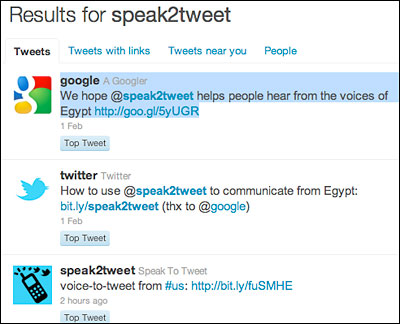
As the Mubarak government turned Egypt into Gypt (everything “e” was cut off), Twitter quickly joined hands with SayNow (a Google company, yes,) to work around the ban and created @speak2tweet. This amazing new “channel,” created for the people of Egypt, is a game changer. It allows for anyone with access to a telephone line to leave a voice message –- which is instantly converted to a tweet.

And what’s really sweet is that it all came from official sources. The top tweets about @speak2tweet were from Google and Twitter, not from some nerd in a back office in Cairo. And the people of Egypt aren’t going to forget that in a hurry. In the past, Egypt has been called Facebook Nation, for the times that general strikes have been organized and mobilized using the power of social media and the popularity of Facebook amongst the young, urban population in Egypt.

This time around, Google and Twitter are the leading facilitators. A joint statement coming from SayNow and Google MENA said “Like many people, we’ve been glued to the news unfolding in Egypt and thinking of what we could do to help people on the ground,” and added a strong note of support with “We hope that this will go some way to helping people in Egypt stay connected at this very difficult time. Our thoughts are with everyone there.” Wow. Well done social.

I managed to connect with Ahmed, one of those Egyptians who’ve grasped the power of the importance of free expression. He said, “It’s not religious, it’s not political. It’s social. Today, I don’t care if you’re Muslim or Christian, today I want to know if you’re social” (meaning if you are able to connect via a social media channel and spread the word).

As I post, my Twitter feed is continuously showing voice tweets coming out of Egypt. It’s very early morning there on Thursday, Feb. 3. The vigil is continuing, and some of the pro-Mubarak supporters (apparently organized and rustled up quickly by the government) have opened fire, injuring several in the pro-freedom crowd. It’s beginning to go south. Violence is flaring.

I’m keeping up with the news, tweet by tweet, live from the square. I’ll post a couple here. Then I’ll have to go work. Write up yet another presentation for a pitch selling the power of social media. For a fast moving consumer goods client. But, for now, from #Egypt:

#egypt #Jan25 Just saw a protester hit by a Molotov. Saw him catch on fire. Other protesters managed to put him out.

We just knew that one of the demonstrators just died from live bullet shot by the NDP thugs here in Tahrir Sq. #Egypt #Jan25

Continued gunfire from #Tahrir #jan25 #Egypt

Just witnessed a guy getting shot in the head. On Al Jazeera. In Egypt. #jan25

And a call out to the US of A. Thugs waited until west asleep to attack! CALL US state department to condemn use of US weapons to kill Egyptians 202-647-4000 #Jan25 #Egypt

Posted on February 18, 2011